Crypto payments
Stablecoins as a Payment Method: What It Means to Get Paid in USDT or USDC
By Robert H.
Stablecoins as a payment method are booming. Learn why USDT and USDC are growing and how to keep clean books on your crypto income.
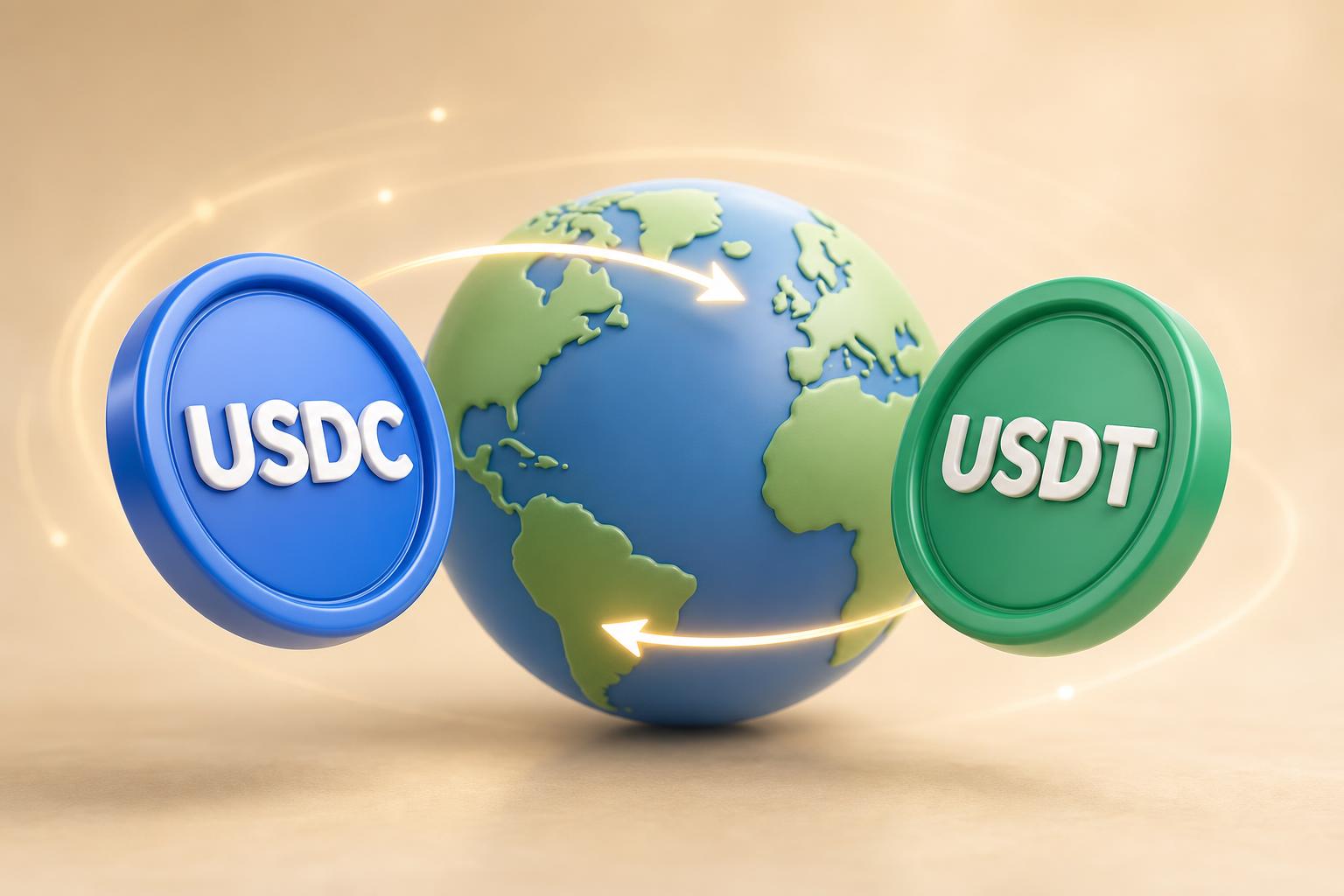
Stablecoins as a payment method have broken through in a short space of time. More and more freelancers, self-employed professionals and businesses are now paid in USDT or USDC instead of euros through a bank. A few years ago these dollar-pegged tokens were mostly a tool for traders, but in 2026 they have become a serious way to pay. The two largest, USDT from Tether and USDC from Circle, together settle a transaction volume that rivals established payment networks. In 2025 roughly 33 trillion dollars in stablecoins moved across the various blockchains.
This article looks at why stablecoins are gaining ground so quickly as a payment method, who the companies behind USDT and USDC are, why these tokens are becoming more trustworthy, and what it means for your bookkeeping when you get paid in them.
What a stablecoin actually is
A stablecoin is a cryptocurrency pegged to a stable value, usually the US dollar. One USDT or USDC is designed to always be worth about one dollar. That makes them fundamentally different from bitcoin or ethereum, which can swing sharply in price. A stablecoin combines the best of two worlds: the speed and borderless nature of crypto, with the stability of an ordinary currency.
Overview pages such as those from CoinMarketCap and CoinGecko show at a glance how large this category has become. The combined market value of all stablecoins runs into the hundreds of billions of dollars, and USDT and USDC account for the lion's share of it.
Why stablecoins are breaking through as a payment method
Four practical advantages explain why more and more clients and businesses pay in stablecoins.
Speed. A stablecoin payment usually settles within seconds to minutes, even across borders. An international bank transfer can easily take several days.
Cost. On networks like Tron or Solana a stablecoin transaction often costs less than a euro, regardless of the amount. For anyone who pays or gets paid across borders regularly, that is a significant saving compared to the fees charged by banks and traditional money transfer services.
No borders or opening hours. A blockchain never stops. Stablecoins move 24 hours a day, seven days a week, including weekends and holidays.
A digital dollar in unstable economies. In countries with high inflation, millions of people simply use USDT and USDC as a way to hold and spend dollars without a US bank account.
Those advantages are no longer theory. Stripe processes USDC payments for merchants in more than seventy countries, MoneyGram offers USDC on- and off-ramps in over two hundred countries through the Stellar network, and Meta began paying creators in USDC via Stripe this year. For a growing group of independent professionals, getting paid in stablecoins is now simply part of the job.
Tether: the market leader behind USDT
USDT is by far the largest stablecoin in the world. The token has a market value of around 186 billion dollars, placing it in the top three of all cryptocurrencies, behind only bitcoin and ethereum. Its user base is approaching 500 million, and more than sixty percent of all USDT circulates on the Tron network, where transactions are cheap and predictable. That explains why USDT is so dominant in emerging markets.
Behind USDT sits Tether Limited, a company originally incorporated in the British Virgin Islands. The token is, according to the company, fully backed by a reserve portfolio of more than 190 billion dollars, with the largest part, roughly 141 billion dollars, held in short-term US government debt. That makes Tether one of the largest holders of US Treasuries in the world, larger than many countries. The reserves are further spread across cash, corporate bonds, gold and bitcoin, among other assets.
Tether publishes a quarterly attestation from accounting firm BDO confirming that its reserves cover the outstanding USDT. Historically this is also where the heaviest criticism landed: for a long time the reserves were not fully and independently audited, and in the past the USDT price briefly slipped below the dollar. Reserve transparency therefore remains the main point of attention for anyone using USDT. To align better with new US regulation, Tether launched USA₮, a separate, compliance-focused dollar token for the US market.
Circle: the regulated challenger behind USDC
USDC is the second largest stablecoin on the market, with a market value of around 73 to 77 billion dollars. Smaller than USDT, but distinctive on one important point: USDC has become the stablecoin of choice for parties that value oversight and transparency.
Behind USDC sits Circle, a company headquartered in New York. Unlike Tether, Circle is a publicly listed company: since June 2025 it has traded on the New York Stock Exchange under the ticker CRCL. That means Circle's financials fall under the supervision of the US securities regulator, the SEC, and are public. Circle also holds a BitLicense from the New York regulator, is registered with FinCEN, and the dollar reserves behind USDC are managed by asset manager BlackRock in a regulated money market fund. Every month Circle publishes an attestation from accounting firm Deloitte on the reserves.
That regulated setup is exactly why large companies choose USDC. Visa, Mastercard, BNY Mellon, Stripe and BlackRock all run USDC integrations. When Meta looked for a trustworthy, US-based issuer to pay creators in stablecoins, it chose Circle over its competitors for that reason.
Why stablecoins are becoming more trustworthy
The biggest shift of the past two years is not technical but legal. Two legislative frameworks have lifted stablecoins from a grey area to a regulated financial product.
In the United States, the so-called GENIUS Act gave stablecoins their first federal legal framework. In Europe, the MiCA regulation did the same for the entire European Union. MiCA sets strict requirements for a stablecoin's reserves and redeemability, and from 1 July 2026 issuers need a full license to offer their services within the EU.
That regulation is precisely why trust is increasing. A stablecoin that complies with MiCA must be demonstrably fully backed by high-quality, liquid reserves, and holders must always be able to redeem their tokens one to one for euros or dollars. USDC is currently the only one of the ten largest stablecoins that is fully MiCA-compliant, alongside the euro variant EURC from the same company. For European users and businesses that is an important difference: it means USDC can still be used without problems inside the EU after MiCA is fully in force.
Getting paid in stablecoins: and then your bookkeeping
This is where the flip side comes in. When you get paid in USDT or USDC, you do not receive a tidy bank statement in euros. You receive transactions on a blockchain, in dollars, at fluctuating exchange rates. For your bookkeeping and the tax authority you still need to know what each payment was worth in euros at the moment you received it, which payments belong to which client or invoice, and what you actually earned.
Tracking that by hand in a spreadsheet is error-prone and time-consuming. That is exactly what STBL Admin was built for. STBL Admin reads your wallet, converts every payment you receive into its euro value at the moment of receipt, lets you link payments to clients and invoices, and produces a clean handover for your bookkeeper. Importantly, STBL Admin never touches your funds and only has read access to your public transaction data. You keep full control over your wallet at all times.
That way the benefits of getting paid in stablecoins, fast, cheap and borderless, stay intact without your bookkeeping turning into a mess.
Looking ahead
Stablecoins have shifted in a short time from a trading instrument to a fully fledged payment method. USDT remains dominant thanks to its enormous scale and popularity in emerging markets, while USDC positions itself as the regulated choice for businesses and the European market. Now that both the United States and Europe have a clear legal framework, the question is no longer whether stablecoins will become a permanent part of the payment system, but how fast. And for anyone already being paid in them, clean bookkeeping is the difference between ease and hassle.
Getting paid in stablecoins and want to track your crypto income effortlessly? Discover how STBL Admin handles your bookkeeping.
Bookkeeper-ready in minutes
Connect a wallet, match payments to invoices and export clean reports your bookkeeper can actually use.
Get started